Four building blocks every nonprofit needs to succeed—and how they hold each other up
©NPH Consulting LLC
You’ve spotted a real need in your community. You can see what would help. Maybe you’ve even sketched out a plan. Then comes the question that keeps founders and board chairs up at night: How do we build an organization that can actually carry this out—and keep carrying it out, year after year?
It can feel overwhelming. It doesn’t have to be.
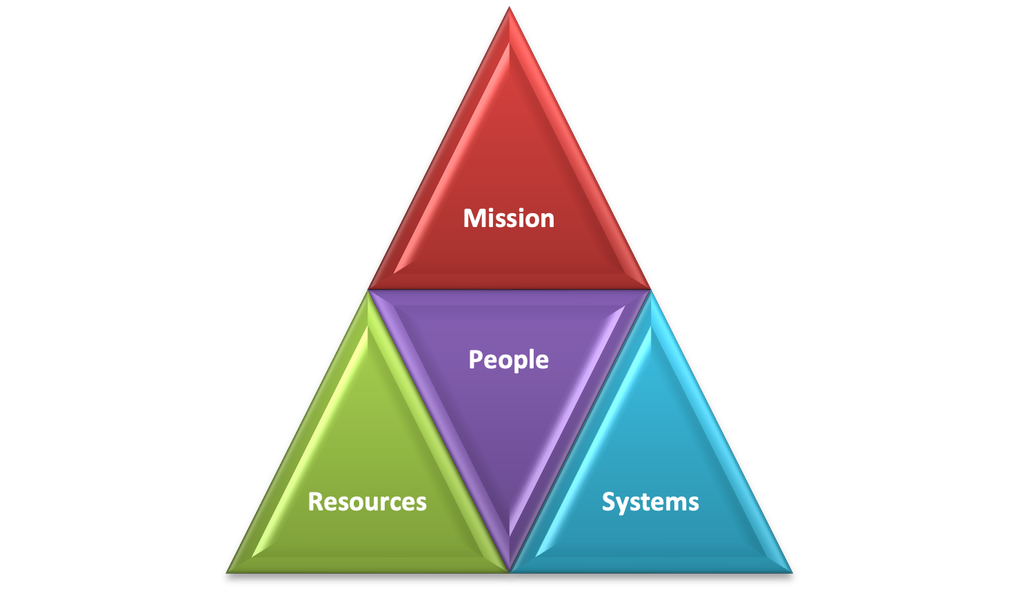
Look closely at any nonprofit that thrives over the long haul, and the same factors always rise to the top. Picture them as a pyramid:
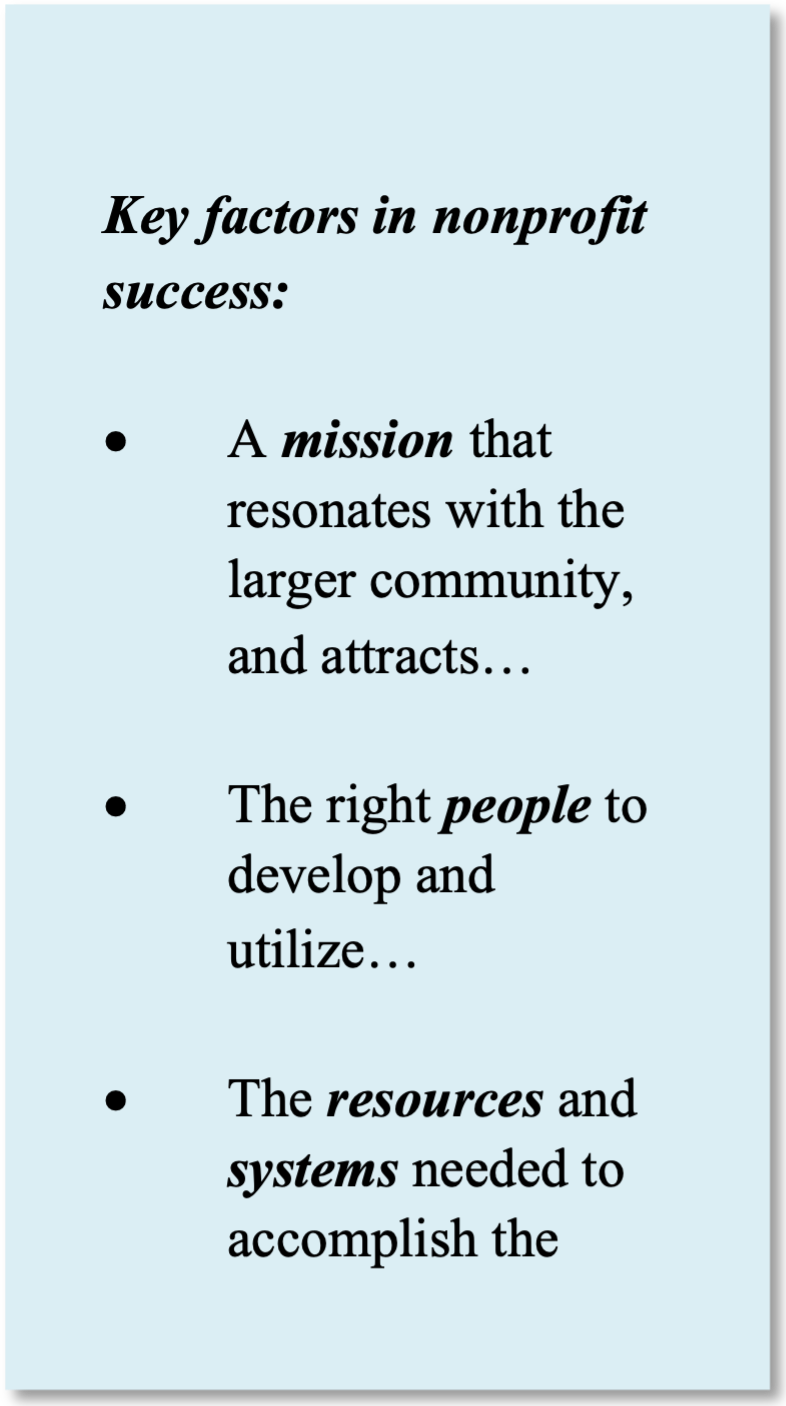
- Mission – the capstone: a purpose that resonates with the larger community
- People – the right ones to accomplish it
- Resources – what those people need to do the work
- Systems – the structures that support them in doing it well
Each building block supports the others. Let’s climb the pyramid, one level at a time.
Mission: The Capstone
Mission matters. It’s the reason your organization exists, and it sits at the top of the pyramid for good reason: your mission is what attracts the right people to you. Those people, in turn, help you build and use the resources and systems that bring the mission to life.
That means your mission can’t live only in a framed statement on the wall. It should be affirmed in everything you do:
- The way you answer the phone
- How you greet clients in the hallway
- What your website communicates
- How your employees talk about their work to their friends
Picture this. In a motivational video for a college basketball team, the speaker stands in the arena and reaches down to touch the team logo painted in the middle of the gym floor. “This is what it’s all about,” he says. “This is what’s on the floor. This is what’s on your shirt. This is what’s in your heart.”
“This is what’s in your heart.”
Sports teams do a great job of branding and rallying support around their goals. A nonprofit is only like a sports team in some ways—but one way it’s like a good team is the collective determination to achieve its mission. That determination should be in the heart of every team member, from board leadership to staff to volunteers.
And it needs to be affirmed constantly. You don’t have to paint an expensive logo on the floor. But whenever you invest in visual symbols and communication, make them affirmative reminders of your mission. (For more on the symbolic side of organizations, Bolman and Deal’s excellent book Reframing Organizations is well worth a read.)
Every planning session should start here: affirming (or changing) your mission, and figuring out how to achieve it.
The hard questions are the important questions. Ask yourself:
- Are we making real progress in accomplishing our mission?
- Could someone else achieve our mission better than we can?
- Could we achieve it better by collaborating with other organizations?
People: The Heart of the Work
People can make seeming miracles happen. They move obstacles out of your way, garner resources, connect with clients, and bring transformative gifts of time and talent.
People can also erect walls of nonsupport, alienate key allies, harm clients—even embezzle your funds.
So is it a matter of good people versus bad people? Usually not. It’s about having the right people:
- Those who are truly committed to your mission
- Those who best fit within your organization
- Those who can give you what you need—and whose own needs are fulfilled by what you offer
“People” means everyone in your orbit: the board, executive leadership, staff, volunteers, donors, and clients. Many wear more than one hat. Clients often become volunteers and donors. Volunteers are frequently donors, and vice versa. Board members may play, or have played, every one of those roles on top of their leadership role.
The right people don’t just support your mission—they’re driven to accomplish it.
These are the people who will help you build the resources and systems you need to carry out that mission.
Resources: Fuel for the Mission
Let’s face it: without funding, nonprofit doors close.
But where do resources come from? They come from people—from connections and relationships. If you have the right people, you’re already building bridges to resources. But those bridges don’t materialize without effort.
Fundraising question: What’s the number one reason people don’t give to a specific organization?
Answer: They weren’t asked to.
It sounds almost too simple. But the ask matters.
And resources are more than money. They include:
- Space and facilities
- Tools, equipment, and materials
- Data
- Transportation
- In-kind donations
- Connections to the services or items your clients need
Without these, the job can’t get done. Cash is important, but it isn’t enough by itself—it’s a tool for investing in the specific resources your work requires. Which tools do you need? That’s a key question to answer during strategic planning, and it will be answered by the people who plan with you for success.
Systems: The Foundation That Lets You Grow
Systems are often the part of the pyramid nobody thinks about—until they have to.
The need usually rears its head during a growth spurt or a period of change, right about the time everyone no longer knows what’s going on in the organization. Suddenly, issues pop up around communication, clarity, boundaries, and other areas that used to be “taken for granted.”
Strong systems change that. With them in place, people can stop wondering and worrying about what they’re supposed to do and how to do it—and get to work.
What kinds of systems are we talking about?
- IT systems (including AI) organize data and make it useful for analysis and communication.
- Financial systems allocate, account for, and protect your financial assets.
- HR policies and procedures organize and support your personnel.
- Communications processes engage people and hold them together around your mission.
- Plans are systems too: your strategic plan is an organizing system, as are your program plans and procedures.
Here’s the thing: you have systems whether or not you recognize and invest in them. In a very small nonprofit, a system can be a pen and paper—or even the brain of one very organized leader. But for a nonprofit of any size in today’s world, that’s unlikely to be enough for long-term success and viability.
Putting It All Together
It all sounds so simple, doesn’t it? Just get a good mission, and people will line up to help achieve it. Then resources will flow like a river, you can invest in all the latest and greatest systems, and success is just around the corner!
If only.
We all know it’s not that simple. Nonprofit work is a labor of love that requires an enormous level of commitment from dawn to dusk—and starts over again every single day. A great mission alone doesn’t work the magic. It takes a plan, constant communication, relationship building, administration, leadership, and creativity to build and sustain a successful nonprofit.
But when you build on every level of the pyramid—a mission that inspires, the right people to pursue it, resources to fuel the work, and systems to hold it all together—you create an organization that doesn’t just succeed. It lasts.
Your next step: Sit down with your board or leadership team and ask two questions. Which part of our pyramid is strongest right now? Which one needs the most attention? That conversation is a great place to start your next strategic plan.
This resource may be freely distributed; please attribute to:
NPH Consulting LLC